

The Human Cost of Economic Meltdown and Its Alternatives
Posted:
Tuesday, October 21, 2008
by Dada Maheshvarananda
 The New York Times editorial calls this "the scariest economic free fall the world has seen since 1929," referring to the Great Depression that caused great suffering to millions. The sentiment is echoed by hundreds of leading economists, bankers and traders whose opinions are quoted daily, as they struggle to explain the economic fallout to the general public. Yet no one is able to confidently predict our economic future.
The US government first bailed out and then, following the lead set by Britain, France, Italy and Spain, began taking over some of the largest financial institutions. How many billions and trillions do they have? Of course the answer is that they already have more than 10 trillion dollars in national debt!
The Human Costs
The human costs of this economic meltdown are only beginning to be felt. More than a million citizens have lost their homes in the past two years, and a million more are expected to lose their homes in the coming12 months. Yet the United States government continues to pay more of the mortgage costs of rich homeowners, through larger tax deductions, than of poorer homeowners.
United States citizens have lost two trillion dollars in retirement funds, representing about 20 percent of their value since last year, reducing the income of everyone and forcing many older working citizens to continue working even into their late sixties. Countless small investors are losing their savings.
The frozen credit market, which is much more serious than the severe stock market declines, will cause companies around the world, unable to borrow, to layoff workers and unemployment will rise.
The Russian stock market fell by about two-thirds since May. Thus, the global financial crisis has wiped out roughly a trillion dollars in wealth across the country.
The country of Iceland itself is failing. Prime Minister Geir Haarde warned of the threat of "national bankruptcy." The government seized its three largest banks to prevent their failure, and the currency had already lost half its value before its trade was halted. The country is desperately seeking an emergency loan from Russia or from the International Monetary Fund (IMF). However accepting the IMF harsh structural adjustment policies to restore fiscal and monetary stability will hurt everyone, an extraordinary reversal for the island's economy, which has been quite affluent for the last decade.
Consumerism and Greed
Greed is the excessive and selfish pursuit of wealth or other material things, without concern whether one's actions deprive others of necessities. Rather than controlling this instinct, unregulated capitalism encourages it. Some proponents of free market capitalism even go so far as to argue that greed should be considered a positive trait because the race to maximize profits propels the global economy. As the character Gordon Gekko in the film Wall Street said, "Greed... is good!"
The meltdown has been caused in large part by corporations that spend hundreds of millions of dollars on advertising campaigns to make debt sound desirable and risk-free. Their sophisticated ad campaigns and direct mail programs are aimed at every age group, from young teenagers to the elderly. The largest credit card company launched a campaign "Life Takes Visa," MasterCard did "Priceless" and Citibank taught "Live Richly." The insidious goal of each of these campaigns was to eliminate negative feelings about going into debt. The creative director of MasterCard's campaign, Jonathan B. Cranin, explained, "One of the tricks in the credit card business is that people have an inherent guilt with spending. What you want is to have people feel good about their purchases."
It gets nastier, because lenders prey on people who urgently need loans to pay for health care and other necessities. To squeeze more profit from borrowers, US credit card companies have increased interest rates from 17.7 percent in 2005 to 19.1 percent last year, a difference that gives them billions of dollars in extra profits. Average late fees rose from less than $13 in 1994 to $35 in 2007, and fees charged when customers exceed their credit limits more than doubled to from $11 to $26 a month.
The lucrative lending practices of these merchants of debt have led millions of North Americans — young and old, rich and poor — to the brink. However in 2005 the bankruptcy laws were changed. This legislation, proposed by President Bush and driven through Congress by financial services firms, makes it much harder for consumers with modest incomes to escape from under their debt by filing for bankruptcy. The new laws encouraged more reckless lending on the part of lenders, because they could more easily force poor borrowers to repay.
Practices such as these that produced record profits for many banks have shaken the world's financial system to its foundation. As a growing number of people default on payments, banks are recording hundreds of billions in losses, devastating their shareholders. As each bank is realizing that it is holding many bad debts, an increasing distrust is taking place between the institutions, afraid of how many bad debts the other banks are holding.
Global economy vs. Local economy
The solution to the global economic meltdown should be the formation of local economies. The first crucial step of any humane economy is to provide the basic necessities of life to all: food and pure water, clothing, housing, education and medical care. Human beings require these in order to realize their individual potentialities, to develop culturally, to achieve inner fulfillment and self-realization, which many now consider as higher goals of life. What a wonderful world it will be when no one on the planet will have to worry about getting enough money to buy the food, clothes, housing, education and medical care needed for his or her family!
Second, the current centralized economies should be decentralized into economically self-reliant regions. The regions would be defined by geographic conditions, and by the inhabitants' cultural legacy, language, economic problems and interests. These bioregions would decide their economic future from below, with planning emerging from the communities and supported by central government policies.
Third, each economic region should also be divided into smaller "blocks" or counties, which would provide the basic level of grassroots economic planning. The area of a county is small enough for the planners to understand all the problems of the area; local leaders would be able to solve the problems according to local priorities; planning would be more practical and effective and give quick, positive results.
Fourth, breaking the dependence on petroleum by rejuvenating local agriculture and achieving self-reliance in food, medicines and energy. The importance of rural employment and an adequate standard of living to reduce internal and external migrations is also important.
Each of these solutions is part of the Progressive Utilization Theory or PROUT, which proposes a dynamic economy of the people, by the people and for the people. Rejecting profit making as the goal of the economy, PROUT bases its economic policy on consumption; that is, on meeting the actual needs of people. PROUT proposes a three-tiered economic system to realize this.
To preserve the creative, innovative spirit of capitalism, but to avoid the destructive, exploiting impact of capital which disregards social costs and environmental degradation, private enterprises should be of small-scale.
The second tier of the PROUT economy is formed by cooperatives. This guarantees economic democracy, a decrease in alienation and a more just distribution of wealth. The goal of cooperatives is not profit at any cost, but satisfying the real needs of the community and achieving everyone's well-being. Members participate in decision-making and determine their community's economic future.
The final tier is industries which have strategic importance and which are too big or too complex to be efficiently managed by a cooperative. For example energy, steel, telecommunications, airlines, etc., should be state-owned and managed by elected boards in the public interest at the national or state levels. These key industries should be run on a no profit, no loss basis, serving all the people of the country.
The Central Bank of each country is such a key industry. However all the other banks should be cooperative credit unions, loaning savings to local businesses, cooperatives and homeowners.
A local economy organized in this way would be human-based, resilient to global market fluctuations and inflation, and able to achieve full employment. Isn't this the type of economy we want?
**********

Dada Maheshvarananda is a yoga monk, activist and writer. He is author of After Capitalism: Prout's Vision for a New World with preface by Noam Chomsky, translated into 10 languages. He is director of the Prout Research Institute of Venezuela. See www.priven.org or write him at maheshvarananda@prout.org
The New York Times editorial calls this "the scariest economic free fall the world has seen since 1929," referring to the Great Depression that caused great suffering to millions. The sentiment is echoed by hundreds of leading economists, bankers and traders whose opinions are quoted daily, as they struggle to explain the economic fallout to the general public. Yet no one is able to confidently predict our economic future. The US government first bailed out and then, following the lead set by Britain, France, Italy and Spain, began taking over some of the largest financial institutions. How many billions and trillions do they have? Of course the answer is that they already have more than 10 trillion dollars in national debt!
The Human Costs
The human costs of this economic meltdown are only beginning to be felt. More than a million citizens have lost their homes in the past two years, and a million more are expected to lose their homes in the coming12 months. Yet the United States government continues to pay more of the mortgage costs of rich homeowners, through larger tax deductions, than of poorer homeowners.
United States citizens have lost two trillion dollars in retirement funds, representing about 20 percent of their value since last year, reducing the income of everyone and forcing many older working citizens to continue working even into their late sixties. Countless small investors are losing their savings.
The frozen credit market, which is much more serious than the severe stock market declines, will cause companies around the world, unable to borrow, to layoff workers and unemployment will rise.
The Russian stock market fell by about two-thirds since May. Thus, the global financial crisis has wiped out roughly a trillion dollars in wealth across the country.
The country of Iceland itself is failing. Prime Minister Geir Haarde warned of the threat of "national bankruptcy." The government seized its three largest banks to prevent their failure, and the currency had already lost half its value before its trade was halted. The country is desperately seeking an emergency loan from Russia or from the International Monetary Fund (IMF). However accepting the IMF harsh structural adjustment policies to restore fiscal and monetary stability will hurt everyone, an extraordinary reversal for the island's economy, which has been quite affluent for the last decade.
Consumerism and Greed
Greed is the excessive and selfish pursuit of wealth or other material things, without concern whether one's actions deprive others of necessities. Rather than controlling this instinct, unregulated capitalism encourages it. Some proponents of free market capitalism even go so far as to argue that greed should be considered a positive trait because the race to maximize profits propels the global economy. As the character Gordon Gekko in the film Wall Street said, "Greed... is good!"
The meltdown has been caused in large part by corporations that spend hundreds of millions of dollars on advertising campaigns to make debt sound desirable and risk-free. Their sophisticated ad campaigns and direct mail programs are aimed at every age group, from young teenagers to the elderly. The largest credit card company launched a campaign "Life Takes Visa," MasterCard did "Priceless" and Citibank taught "Live Richly." The insidious goal of each of these campaigns was to eliminate negative feelings about going into debt. The creative director of MasterCard's campaign, Jonathan B. Cranin, explained, "One of the tricks in the credit card business is that people have an inherent guilt with spending. What you want is to have people feel good about their purchases."
It gets nastier, because lenders prey on people who urgently need loans to pay for health care and other necessities. To squeeze more profit from borrowers, US credit card companies have increased interest rates from 17.7 percent in 2005 to 19.1 percent last year, a difference that gives them billions of dollars in extra profits. Average late fees rose from less than $13 in 1994 to $35 in 2007, and fees charged when customers exceed their credit limits more than doubled to from $11 to $26 a month.
The lucrative lending practices of these merchants of debt have led millions of North Americans — young and old, rich and poor — to the brink. However in 2005 the bankruptcy laws were changed. This legislation, proposed by President Bush and driven through Congress by financial services firms, makes it much harder for consumers with modest incomes to escape from under their debt by filing for bankruptcy. The new laws encouraged more reckless lending on the part of lenders, because they could more easily force poor borrowers to repay.
Practices such as these that produced record profits for many banks have shaken the world's financial system to its foundation. As a growing number of people default on payments, banks are recording hundreds of billions in losses, devastating their shareholders. As each bank is realizing that it is holding many bad debts, an increasing distrust is taking place between the institutions, afraid of how many bad debts the other banks are holding.
Global economy vs. Local economy
The solution to the global economic meltdown should be the formation of local economies. The first crucial step of any humane economy is to provide the basic necessities of life to all: food and pure water, clothing, housing, education and medical care. Human beings require these in order to realize their individual potentialities, to develop culturally, to achieve inner fulfillment and self-realization, which many now consider as higher goals of life. What a wonderful world it will be when no one on the planet will have to worry about getting enough money to buy the food, clothes, housing, education and medical care needed for his or her family!
Second, the current centralized economies should be decentralized into economically self-reliant regions. The regions would be defined by geographic conditions, and by the inhabitants' cultural legacy, language, economic problems and interests. These bioregions would decide their economic future from below, with planning emerging from the communities and supported by central government policies.
Third, each economic region should also be divided into smaller "blocks" or counties, which would provide the basic level of grassroots economic planning. The area of a county is small enough for the planners to understand all the problems of the area; local leaders would be able to solve the problems according to local priorities; planning would be more practical and effective and give quick, positive results.
Fourth, breaking the dependence on petroleum by rejuvenating local agriculture and achieving self-reliance in food, medicines and energy. The importance of rural employment and an adequate standard of living to reduce internal and external migrations is also important.
Each of these solutions is part of the Progressive Utilization Theory or PROUT, which proposes a dynamic economy of the people, by the people and for the people. Rejecting profit making as the goal of the economy, PROUT bases its economic policy on consumption; that is, on meeting the actual needs of people. PROUT proposes a three-tiered economic system to realize this.
To preserve the creative, innovative spirit of capitalism, but to avoid the destructive, exploiting impact of capital which disregards social costs and environmental degradation, private enterprises should be of small-scale.
The second tier of the PROUT economy is formed by cooperatives. This guarantees economic democracy, a decrease in alienation and a more just distribution of wealth. The goal of cooperatives is not profit at any cost, but satisfying the real needs of the community and achieving everyone's well-being. Members participate in decision-making and determine their community's economic future.
The final tier is industries which have strategic importance and which are too big or too complex to be efficiently managed by a cooperative. For example energy, steel, telecommunications, airlines, etc., should be state-owned and managed by elected boards in the public interest at the national or state levels. These key industries should be run on a no profit, no loss basis, serving all the people of the country.
The Central Bank of each country is such a key industry. However all the other banks should be cooperative credit unions, loaning savings to local businesses, cooperatives and homeowners.
A local economy organized in this way would be human-based, resilient to global market fluctuations and inflation, and able to achieve full employment. Isn't this the type of economy we want?
**********
Dada Maheshvarananda is a yoga monk, activist and writer. He is author of After Capitalism: Prout's Vision for a New World with preface by Noam Chomsky, translated into 10 languages. He is director of the Prout Research Institute of Venezuela. See www.priven.org or write him at maheshvarananda@prout.org
2nd MBS: Initiatives for Social Media Cultural Dialogue
Posted:
Wednesday, October 01, 2008
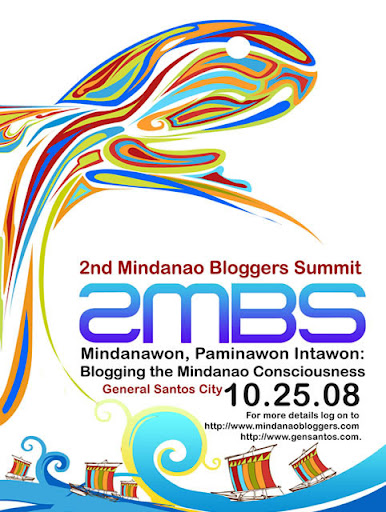
Who are we to define this Mindanawon Consciousness?
In this process, we could be haunted by doubt. Who are we to define Mindanawon consciousness? Isn't this an exercise of power and domination? In reality, that is not what we want to do. We want to look forward a way of speaking about Mindanao, a set of social images that can give us some control on how Mindanao can nurture multicultural understanding, peace, development, and a sense of meaning and identity. We want to generate new collective energies.
Objectives of the Summit
- To strengthen the unity among bloggers in their drive to accentuate the untapped potentialities of Mindanao,
- To encourage bloggers to become more enthusiastic about the Mindanao consciousness,
- To utilize maximum potential of new social media, and
- To foster the entrepreneurial spirit of Mindanawans through blogging.
The Panel Discussion Resource Speakers
| Looking South: An Outsider Pundits about Mindanao Politics, History and Commentary |  http://www.quezon.ph |
| Voices from Mindanao Heartroots: Notes on Life & Living in the Communitiests: |  http://istambay.wordpress.com |
| “Mindanawon Consciousness” |  http://www.writingedge.co.cc |
| Tips and New Media for Mindanao Bloggers |  http://www.aileenapolo.com |
| Blogging the Entrepreneurial Way of Life |  http://www.riajose.com |
| Images of Mindanao from the perspective of a Mindanaoan |  |
The Ferment of Change: A Case for Maharlika
Posted:
Thursday, August 14, 2008
By Eddie U. Ilarde
Even more hostile was the accusation that the bill was drawn-up by President Ferdinand Marcos himself, "Maharlika" having been associated with him during the war when he named his guerrilla unit to fight the Japanese invaders “Maharlika.” If true, the bill would have passed without question in that “rubber stamp congress.” But the measure did not even merit a committee hearing. The consoling thought however is, the bill was ahead of its time in a country long indoctrinated to accept blindly historical inaccuracies and Western hegemony and culture—the people made averse to resisting a deeply rooted conservative status quo as a consequence.
“The times are changing” is an affirmation of present circumstances. Today we see encouraging developments in favor of our proposal, but only after 27 years. Opposition has started to give way to an open mind by the same people who yesterday sneered at it.
Recently we have been receiving letters mostly from Filipinos abroad asking if our proposal to rename the country is still alive, realizing the relevance today. This country’s image in the eyes of the world today is at its worst, tarnished by such epithets as “the most corrupt country in the world,” a nation of cheats and thieves,” “a country of slums and hungry children,” “the dirtiest country in the world,” and other negative exaggerations. Heir common complaint: “We are constantly humiliated as “Filipinos’ in our host countries with insults like ‘the Philippines is a country of prostitutes, maids, thieves,’ and other indignitaries we cannot swallow any longer.” The shared optimism is “if we become Maharlikans this Filipino identity shall be erased forever and the world shall take notice and stop insulting our country as we create a new image and rebuild our reputation.
Great thinkers and visionaries have some time derived their thoughts and judgment from the common people. We must take our cue from this urgent call. If we don’ move this country shall be left behind by then winds of progress. In this country the wheels of change are heavy and slow. Our people are averse to change and are easily disinclined to anything outside the scope of easy comprehension. It is time to find the psychological why and wherefore and from there we must find the catharsis to expel this negative nature. Simple experiment al applications of new ways to improve existing conditions are always met with contempt, which lead to protracted squabbling and to miscarriage of good intentions. “Let us keep what we have; the known evil is best,” describes us best.
Our people's character of easily accepting “what is there and what is given” is so ingrained; what were imposed upon us in 1543 have coarsely acquired lasting currency through the centuries. The “ferment of change” addressed by other counties in Asia, Africa, Europe, and in other regions, we have ignored. Formosa, Siam, Dutch East Indies, French Indochina, Malaya, Ceylon, Burma, Khmer/Kampuchea, Persia, Bombay, Calcutta, to name only a few have all changed their names. We have remained as is even as we behold the phenomenal economic growth of these neighbors brought about by a compulsion for change back to the reassured ethos of their past which served as the touchstone for their quest for progress and prosperity.
Our penchant for change is so trivial, proven by changing only the names of streets and other minor things and places. Dewey Blvd. is changed to Roxas Blvd. because Dewey was American; Azcarraga to Recto because Azcarraga was Spaniard, etc. The country is named after King Philip II of Spain. Have we ever asked ourselves what kind of a man we were named after?
 Philip was only ¼ Spaniard, his father Charles V was Hapsburg and did not even speak a word in Spanish when he became a king. Philip was as some historians call “a monster of bigotry, ambition, lust and cruelty.” His own official court historian described him as a man whose “smile and dagger were very close.” He was the son of fist cousins. His grandmother Juana died of insanity. Even today she is known in Spain as “Juana la loca.” His “auto-da-fe” after being sworn in as king was the burning in the stake alive of thousands of Muslims in Spain. Protestants in Europe, then under Spain were beheaded as heretics. He was ex-communicated as a Catholic by the pope for looting Rome. He died of what historians evasively described as a very communicable social disease (syphilis) that had affected his mind. Before he died thousands of insects festered his whole body which was covered with ulcers dripping with puss and reeking with unbearable smell. His name is better forgotten whose unpleasant memory we still honor today by identifying ourselves as Filipinos, carrying his name with pride.
Maharlika is our ancient heritage and has been with us long before Western colonialists set foot on our shoes. Maha is Sanskrit for noble, great, as in Taj Mahal. Mahatma (a great soul); the moon that supports all the planets and celestial bodies,” “The food that nourishes vital forces in everyone, “chanting Maha is to be one with the Lord,” “Maha is God Himself.” The inflectional ending of Maharlika, Likha is our own word for create, make, cause, design, breed, conceived, Maharlika therefore means “nobly created,” “God’s creation,” “the self personified,” etc. The great philosopher-philologist-spiritual master P.R. Sarkar said, “Maharlika means a small container (country) containing great things (people).” Maharlika is a spiritual mantra, a divine name.
The name “Filipino” has obscenely outlasted is purpose and has become malapropos. We only need it as much as we need a tragic memory. Our people must hear from our leaders in government, business, the academe, and from our opinion makers. Maharlika shall be the precursor of the great transformation of this country; it shall inspire a romantic tale, nay, a great national epic which is absent in our present annals. Maharlika shall discover our true identity, then beginning of our renaissance, our rebirth to greatness.
[Eddie Ilarde is a former councilor, congressman, senator, and assemblyman. He is a Lifetime Achievement Awardee for radio and television having pioneered many programs of lasting value to the country. He is the founder of Maharlika Foundation for National Transformation and Golden Eagles Society International, a movement to benefit the older people of the world. Kuya Eddie, as he is fondly called is semi-retired author and free-lance writer and spends his time in his small arm in the province].
Astonishment and wonder were the unfavorable reactions of our peers in the Interim Batasang Pambansa when we filed Parliamentary Bill 195 on August 14, 1978 seeking to change the name Philippines to Maharlika. It was as if to say “some members have lost their marbles to even contemplate such a thing”, as if they didn’t know that Article XVI, Section 2 of the constitution says that “The Congress, may by law, adopt a new name for the country x x x x which shall be truly reflective and symbolic of the ideals, history, and traditions of the people x x x such law shall take effect only upon ratification by the people min a national referendum.”
Even more hostile was the accusation that the bill was drawn-up by President Ferdinand Marcos himself, "Maharlika" having been associated with him during the war when he named his guerrilla unit to fight the Japanese invaders “Maharlika.” If true, the bill would have passed without question in that “rubber stamp congress.” But the measure did not even merit a committee hearing. The consoling thought however is, the bill was ahead of its time in a country long indoctrinated to accept blindly historical inaccuracies and Western hegemony and culture—the people made averse to resisting a deeply rooted conservative status quo as a consequence.
“The times are changing” is an affirmation of present circumstances. Today we see encouraging developments in favor of our proposal, but only after 27 years. Opposition has started to give way to an open mind by the same people who yesterday sneered at it.
Recently we have been receiving letters mostly from Filipinos abroad asking if our proposal to rename the country is still alive, realizing the relevance today. This country’s image in the eyes of the world today is at its worst, tarnished by such epithets as “the most corrupt country in the world,” a nation of cheats and thieves,” “a country of slums and hungry children,” “the dirtiest country in the world,” and other negative exaggerations. Heir common complaint: “We are constantly humiliated as “Filipinos’ in our host countries with insults like ‘the Philippines is a country of prostitutes, maids, thieves,’ and other indignitaries we cannot swallow any longer.” The shared optimism is “if we become Maharlikans this Filipino identity shall be erased forever and the world shall take notice and stop insulting our country as we create a new image and rebuild our reputation.
Great thinkers and visionaries have some time derived their thoughts and judgment from the common people. We must take our cue from this urgent call. If we don’ move this country shall be left behind by then winds of progress. In this country the wheels of change are heavy and slow. Our people are averse to change and are easily disinclined to anything outside the scope of easy comprehension. It is time to find the psychological why and wherefore and from there we must find the catharsis to expel this negative nature. Simple experiment al applications of new ways to improve existing conditions are always met with contempt, which lead to protracted squabbling and to miscarriage of good intentions. “Let us keep what we have; the known evil is best,” describes us best.
Our people's character of easily accepting “what is there and what is given” is so ingrained; what were imposed upon us in 1543 have coarsely acquired lasting currency through the centuries. The “ferment of change” addressed by other counties in Asia, Africa, Europe, and in other regions, we have ignored. Formosa, Siam, Dutch East Indies, French Indochina, Malaya, Ceylon, Burma, Khmer/Kampuchea, Persia, Bombay, Calcutta, to name only a few have all changed their names. We have remained as is even as we behold the phenomenal economic growth of these neighbors brought about by a compulsion for change back to the reassured ethos of their past which served as the touchstone for their quest for progress and prosperity.
Our penchant for change is so trivial, proven by changing only the names of streets and other minor things and places. Dewey Blvd. is changed to Roxas Blvd. because Dewey was American; Azcarraga to Recto because Azcarraga was Spaniard, etc. The country is named after King Philip II of Spain. Have we ever asked ourselves what kind of a man we were named after?
 Philip was only ¼ Spaniard, his father Charles V was Hapsburg and did not even speak a word in Spanish when he became a king. Philip was as some historians call “a monster of bigotry, ambition, lust and cruelty.” His own official court historian described him as a man whose “smile and dagger were very close.” He was the son of fist cousins. His grandmother Juana died of insanity. Even today she is known in Spain as “Juana la loca.” His “auto-da-fe” after being sworn in as king was the burning in the stake alive of thousands of Muslims in Spain. Protestants in Europe, then under Spain were beheaded as heretics. He was ex-communicated as a Catholic by the pope for looting Rome. He died of what historians evasively described as a very communicable social disease (syphilis) that had affected his mind. Before he died thousands of insects festered his whole body which was covered with ulcers dripping with puss and reeking with unbearable smell. His name is better forgotten whose unpleasant memory we still honor today by identifying ourselves as Filipinos, carrying his name with pride.
Maharlika is our ancient heritage and has been with us long before Western colonialists set foot on our shoes. Maha is Sanskrit for noble, great, as in Taj Mahal. Mahatma (a great soul); the moon that supports all the planets and celestial bodies,” “The food that nourishes vital forces in everyone, “chanting Maha is to be one with the Lord,” “Maha is God Himself.” The inflectional ending of Maharlika, Likha is our own word for create, make, cause, design, breed, conceived, Maharlika therefore means “nobly created,” “God’s creation,” “the self personified,” etc. The great philosopher-philologist-spiritual master P.R. Sarkar said, “Maharlika means a small container (country) containing great things (people).” Maharlika is a spiritual mantra, a divine name.
The name “Filipino” has obscenely outlasted is purpose and has become malapropos. We only need it as much as we need a tragic memory. Our people must hear from our leaders in government, business, the academe, and from our opinion makers. Maharlika shall be the precursor of the great transformation of this country; it shall inspire a romantic tale, nay, a great national epic which is absent in our present annals. Maharlika shall discover our true identity, then beginning of our renaissance, our rebirth to greatness.
[Eddie Ilarde is a former councilor, congressman, senator, and assemblyman. He is a Lifetime Achievement Awardee for radio and television having pioneered many programs of lasting value to the country. He is the founder of Maharlika Foundation for National Transformation and Golden Eagles Society International, a movement to benefit the older people of the world. Kuya Eddie, as he is fondly called is semi-retired author and free-lance writer and spends his time in his small arm in the province].
The Modernization of Islam and the Creation of a Multipolar World Order
Posted:
Wednesday, August 13, 2008
NEW BOOK
 Dr. Susmit Kumar's fascinating work on the modernization of Islam and the creation of
a multipolar world order is out.
Dr. Kumar writes engagingly and with easy authority on the causes of Islamic fundamentalism, the collapse of American economy, and demonstrates the excellent prospects of PROUT in the later part of the book. This comprehensive work succeeds
in placing the idea of PROUT in a temporary political framework underscoring an
upcoming basic shift in values.
Read more the synopsis here »»
 Dr. Susmit Kumar's fascinating work on the modernization of Islam and the creation of
a multipolar world order is out.
Dr. Kumar writes engagingly and with easy authority on the causes of Islamic fundamentalism, the collapse of American economy, and demonstrates the excellent prospects of PROUT in the later part of the book. This comprehensive work succeeds
in placing the idea of PROUT in a temporary political framework underscoring an
upcoming basic shift in values.
Read more the synopsis here »»
The Modernization of Islam is a provocative analysis of the present global Islamic militancy, based on the author’s 1995 article published in Global Times (Copenhagen, Denmark). The 2001 attack on the US and subsequent Western-led attacks on Afghanistan and Iraq have led political scientists to believe in Samuel Huntington’s theory of a "clash of civilizations." The world’s civilizations -Western, Islamic, Chinese, Japanese, Orthodox/Russian, Hindu, African, and Latin - will, according to this theory, align and engage in war on a civilizational basis. Although experts predict that Islamic militancy will last three to four decades, they are unable to predict its final outcome. Until 1900 no one was predicting that democracy would replace kingdoms in most European countries, or that Asian and African countries would gain independence within five to six decades. But, because of World Wars I and II, most European kingdoms were replaced by vibrant democracies, and colonial rulers had to leave most of Asia and Africa due to the destruction wrought on their economies during these wars. In order to give birth to a beautiful child, a woman has to go through the pains of labor. Europe had some of its labor pains in the last century, when World Wars I and II were necessary to change the global socio-economic and political environments of those times. Had those wars not occurred, much of Europe might still be ruled by monarchs, and most Asian and African countries might still be awaiting independence from their colonial masters. Islam is the only major religion imposed by government fiat anywhere in the world. Today Islamic civilization is going through what Europe went through between World Wars I and II. At the end of this crisis, the majority of Islamic nations will become secular and democratic, like Turkey: the world seat of the Islamic Caliphate since 1517, Turkey shed its fundamentalist rule in 1923 and has remained free ever since.
Main chapters include:
You may check out the book here, and purchase the book at Amazon
- Causes and Consequences of World Wars I and II
- Victims of the Cold War and the Rise of a Fundamentalist Islamic Frankenstein
- The History of Islam and The Islamic Empires
- Islamic Civilization in Turmoil
- The Collapse of the American Economy
- The Modernization of Islam
- Capitalism, PROUT and Deficiencies of Democracy
You may check out the book here, and purchase the book at Amazon
Necessity for economic democracy
Posted:
Tuesday, August 05, 2008
By P.R. Sarkar
The first requirement for economic democracy is that the minimum requirements of a particular age -- including food, clothing, housing, education and medical treatment -- must be guaranteed to all. Not only is this an individual right, it is also a collective necessity, because the easy availability of the minimum requirements will increase the all-round welfare of society.
The second requirement for economic democracy is that increasing purchasing capacity must be guaranteed to each and every individual. In economic democracy local people will hold economic power. Consequently, local raw materials will be used to promote the economic prosperity of the local people. That is to say, the raw materials of one socio-economic unit should not be exported to another unit. Instead, industrial centres should be built up wherever raw materials are available. This will create industries based on locally available raw materials and ensure full employment for all local people.
The third requirement for economic democracy is that the power to make all economic decisions must be placed in the hands of the local people. Economic liberation is the birthright of every individual. To achieve it, economic power must be vested in the local people. In economic democracy the local people will have the power to make all economic decisions, to produce commodities on the basis of collective necessity, and to distribute all agricultural and industrial commodities.
The fourth requirement for economic democracy is that outsiders must be strictly prevented from interfering in the local economy. The outflow of local capital must be stopped by strictly preventing outsiders or a floating population from participating in any type of economic activity in the local area. For the success of economic democracy, Prout must be implemented and the economic welfare of all people must be enhanced step by step. This in turn will lead to greater opportunities for the spiritual emancipation of human beings.
Finally, it should be remembered that economic democracy is essential not only for the economic liberation of human beings, but for the universal well-being of all -- including plants and animals. Economic democracy will devise ways and means to effect the smooth progress of society by recognizing the unique value of both humans and non-humans alike.
June 1986, Calcutta
Prout in a nutshell 21
The first requirement for economic democracy is that the minimum requirements of a particular age -- including food, clothing, housing, education and medical treatment -- must be guaranteed to all. Not only is this an individual right, it is also a collective necessity, because the easy availability of the minimum requirements will increase the all-round welfare of society.
The second requirement for economic democracy is that increasing purchasing capacity must be guaranteed to each and every individual. In economic democracy local people will hold economic power. Consequently, local raw materials will be used to promote the economic prosperity of the local people. That is to say, the raw materials of one socio-economic unit should not be exported to another unit. Instead, industrial centres should be built up wherever raw materials are available. This will create industries based on locally available raw materials and ensure full employment for all local people.
The third requirement for economic democracy is that the power to make all economic decisions must be placed in the hands of the local people. Economic liberation is the birthright of every individual. To achieve it, economic power must be vested in the local people. In economic democracy the local people will have the power to make all economic decisions, to produce commodities on the basis of collective necessity, and to distribute all agricultural and industrial commodities.
The fourth requirement for economic democracy is that outsiders must be strictly prevented from interfering in the local economy. The outflow of local capital must be stopped by strictly preventing outsiders or a floating population from participating in any type of economic activity in the local area. For the success of economic democracy, Prout must be implemented and the economic welfare of all people must be enhanced step by step. This in turn will lead to greater opportunities for the spiritual emancipation of human beings.
Finally, it should be remembered that economic democracy is essential not only for the economic liberation of human beings, but for the universal well-being of all -- including plants and animals. Economic democracy will devise ways and means to effect the smooth progress of society by recognizing the unique value of both humans and non-humans alike.
June 1986, Calcutta
Prout in a nutshell 21
What is PROUT?
Posted:
Saturday, July 26, 2008
PROUT is a complete socio-economic theory based on an integrated view of life and comprising a wide spectrum of human activity, propounded by Shrii Prabhat Rainjan Sarkar (1921-1990) in 1959. At the time it presented an undeniable challenge to the outdated Marxist and capitalist theories whose falls it predicts. Based on practical observances rather than theoretical assumptions, PROUT remains very much a vibrant rational ideological alternative today.
The name PROUT is an acronym of PROgressive Utilization Theory. For the first time human goals and aspirations on any level of existence have been brought within the compass of a comprehensive socio-economic theory. Earlier socio-economic thought could not comprehend a synthetic approach to human physical, mental and spiritual requirements. Hence they could provide neither for the integrated development of individuals nor the wholesome adjustment with others and the environment.
Visit ProutWorld at www.proutworld.org
The name PROUT is an acronym of PROgressive Utilization Theory. For the first time human goals and aspirations on any level of existence have been brought within the compass of a comprehensive socio-economic theory. Earlier socio-economic thought could not comprehend a synthetic approach to human physical, mental and spiritual requirements. Hence they could provide neither for the integrated development of individuals nor the wholesome adjustment with others and the environment.
Visit ProutWorld at www.proutworld.org
Sarangani Bay Festival 2008
Posted:
Saturday, May 17, 2008
Woodbridge Beach Resort in Kiamba hosted the opening program of Sarangani Bay Festival 2008 with simultaneous competitions in land and sea, including environmental awareness programs.

Sarangani Bay lies between a mangrove forest in Glan (foreground) and the majestic Mt. Matutum. -- Photo by Cocoy Sexcion
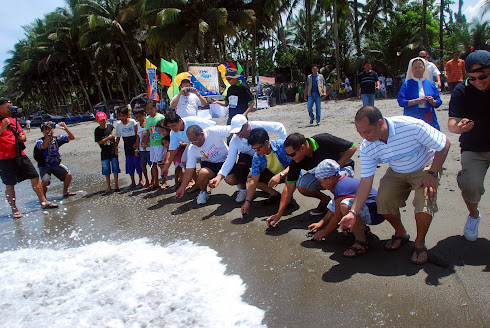
Pawikan release: Local officials led by Governor Migs Dominguez (4th from right) and the community release 30 Olive Ridley hatchlings to signal environmental consciousness and protection of the bay on the first day of Sarangani Bay Festival Friday, May 16 at Kiamba municipality. -- Photo by Cocoy Sexcion
Earlier in the day of May 16, at 7am., a clean-up in the province’s six coastal towns - Alabel, Malapatan, Glan, Maasim, Kiamba and Maitum - ushered in community participation and advocacy for Sarangani Bay.
Also slated at Woodbridge are a rowing race (lumba bugsay), cooking contest (hain kusina), an environmental arts exhibit and a techno-aqua recreational activity.
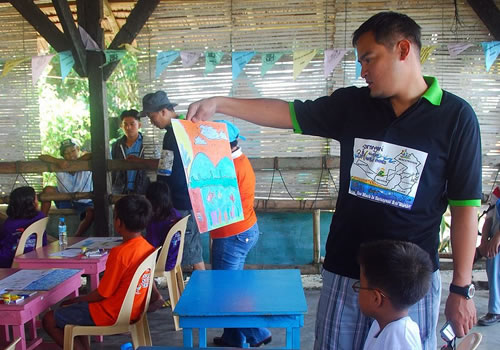
Governor Migs Dominguez looks at the artwork of a participant in the Sining at Kinaiyahan (arts and nature) contest among 8 to 12 years old children Friday, May 16, depicting this year's 2008 Sarangani Bay Festival theme: "Sarangani… Celebrating and Protecting the Treasures of the Bay" -- Photo by Cocoy Sexcion

Fisherfolk teams composed of either husband and wife, father and daughter, sister and brother, or mother and son race boats at the Lumba Bugsay event to open the Sarangani Bay Festival 2008. It is a 1.5-kilometer race from Banglay Beach to Woodbridge Resort. -- Photo by Cocoy Sexcion

Couple Bong and Norhaima Saban reach the finish line first for the Lumba Bugsay at the opening of the Sarangani Bay Festival 2008 Friday, May 16. The couple pose after winning the 1.5-kilometer race carries the top prize of P5,000 cash and a 5.5 HP boat engine. -- Photo by Cocoy Sexcion

Fisherfolk families who participated in the Lumba Bugsay event pose after reaching the shore of Woodbridge Resort at Kiamba municipality. -- Photo by Cocoy Sexcion
For the first time, the municipality of Kiamba launched the “Mountain-River-Ocean Adventure,” a human race from the jungles to the sea.
Local government units, non-government organizations and the business sector are coming together to celebrate this year’s bay festival and to increase community awareness in environmental conservation.
“For our third Sarangani Bay Festival, everybody is knocking on our doors,” Governor Migs Dominguez told a press conference last week.
“This means we’re developing equity and credibility in what we are doing, because our cause is healthy,” the governor said.
Sarangani Bay Festival, with the theme this year of “Sarangani… Celebrating and Protecting the Treasures of the Bay”, is a province-wide festival which pays tribute to the bounty of the bay through beach events.
“We are celebrating the beauty and the goodness of the bay,” said Vice Governor Steve Chiongbian Solon.
“Every year people will be reminded of how beautiful and how generous the bay has become for us that we should continue to preserve it,” Solon said.
According to Board Member Arturo Lawa, Sarangani province has “already generated interest with regards to environmental protection.”
“This is evident in the building of Septage Treatment Facilities from the Japan Bank for International Cooperation among the province’s six coastal towns,” said Lawa, chair of the Sangguniang Panlalawigan environment committee.
Lawa said in relation to the Clean Water Act, his committee was now 80% in the formulation of the Water Quality Management Board for Sarangani Bay.
On the other hand, the annual bay festival has triggered the development of beach resorts across the province to accommodate tourists.
Resort growth more than doubled in the white sand shores of Gumasa, the Boracay-like destination in Mindanao.
The tourism office has recorded an 87% increase of tourist arrivals in the province from 2005 to 2007.
**********
For more information, kindly visit this website: www.sarangani.gov.ph

Sarangani Bay lies between a mangrove forest in Glan (foreground) and the majestic Mt. Matutum. -- Photo by Cocoy Sexcion

Pawikan release: Local officials led by Governor Migs Dominguez (4th from right) and the community release 30 Olive Ridley hatchlings to signal environmental consciousness and protection of the bay on the first day of Sarangani Bay Festival Friday, May 16 at Kiamba municipality. -- Photo by Cocoy Sexcion
Earlier in the day of May 16, at 7am., a clean-up in the province’s six coastal towns - Alabel, Malapatan, Glan, Maasim, Kiamba and Maitum - ushered in community participation and advocacy for Sarangani Bay.
Also slated at Woodbridge are a rowing race (lumba bugsay), cooking contest (hain kusina), an environmental arts exhibit and a techno-aqua recreational activity.

Governor Migs Dominguez looks at the artwork of a participant in the Sining at Kinaiyahan (arts and nature) contest among 8 to 12 years old children Friday, May 16, depicting this year's 2008 Sarangani Bay Festival theme: "Sarangani… Celebrating and Protecting the Treasures of the Bay" -- Photo by Cocoy Sexcion

Fisherfolk teams composed of either husband and wife, father and daughter, sister and brother, or mother and son race boats at the Lumba Bugsay event to open the Sarangani Bay Festival 2008. It is a 1.5-kilometer race from Banglay Beach to Woodbridge Resort. -- Photo by Cocoy Sexcion

Couple Bong and Norhaima Saban reach the finish line first for the Lumba Bugsay at the opening of the Sarangani Bay Festival 2008 Friday, May 16. The couple pose after winning the 1.5-kilometer race carries the top prize of P5,000 cash and a 5.5 HP boat engine. -- Photo by Cocoy Sexcion

Fisherfolk families who participated in the Lumba Bugsay event pose after reaching the shore of Woodbridge Resort at Kiamba municipality. -- Photo by Cocoy Sexcion
For the first time, the municipality of Kiamba launched the “Mountain-River-Ocean Adventure,” a human race from the jungles to the sea.
Local government units, non-government organizations and the business sector are coming together to celebrate this year’s bay festival and to increase community awareness in environmental conservation.
“For our third Sarangani Bay Festival, everybody is knocking on our doors,” Governor Migs Dominguez told a press conference last week.
“This means we’re developing equity and credibility in what we are doing, because our cause is healthy,” the governor said.
Sarangani Bay Festival, with the theme this year of “Sarangani… Celebrating and Protecting the Treasures of the Bay”, is a province-wide festival which pays tribute to the bounty of the bay through beach events.
“We are celebrating the beauty and the goodness of the bay,” said Vice Governor Steve Chiongbian Solon.
“Every year people will be reminded of how beautiful and how generous the bay has become for us that we should continue to preserve it,” Solon said.
According to Board Member Arturo Lawa, Sarangani province has “already generated interest with regards to environmental protection.”
“This is evident in the building of Septage Treatment Facilities from the Japan Bank for International Cooperation among the province’s six coastal towns,” said Lawa, chair of the Sangguniang Panlalawigan environment committee.
Lawa said in relation to the Clean Water Act, his committee was now 80% in the formulation of the Water Quality Management Board for Sarangani Bay.
On the other hand, the annual bay festival has triggered the development of beach resorts across the province to accommodate tourists.
Resort growth more than doubled in the white sand shores of Gumasa, the Boracay-like destination in Mindanao.
The tourism office has recorded an 87% increase of tourist arrivals in the province from 2005 to 2007.
**********
For more information, kindly visit this website: www.sarangani.gov.ph
