

Showing posts with label cultural. Show all posts
Showing posts with label cultural. Show all posts
Chicken a la Carte: A Winning Film
Posted:
Tuesday, May 05, 2009
Director: Ferdinand Dimadura | Genre: Drama | Produced In: 2005
Synopsis: This film is about the hunger and poverty brought about by Globalization. There are 10,000 people dying everyday due to hunger and malnutrition. This short film shows a forgotten portion of the society. The people who live on the refuse of men to survive. What is inspiring is the hope and spirituality that never left this people.
Synopsis: This film is about the hunger and poverty brought about by Globalization. There are 10,000 people dying everyday due to hunger and malnutrition. This short film shows a forgotten portion of the society. The people who live on the refuse of men to survive. What is inspiring is the hope and spirituality that never left this people.

The Ferment of Change: A Case for Maharlika
Posted:
Thursday, August 14, 2008
By Eddie U. Ilarde
Even more hostile was the accusation that the bill was drawn-up by President Ferdinand Marcos himself, "Maharlika" having been associated with him during the war when he named his guerrilla unit to fight the Japanese invaders “Maharlika.” If true, the bill would have passed without question in that “rubber stamp congress.” But the measure did not even merit a committee hearing. The consoling thought however is, the bill was ahead of its time in a country long indoctrinated to accept blindly historical inaccuracies and Western hegemony and culture—the people made averse to resisting a deeply rooted conservative status quo as a consequence.
“The times are changing” is an affirmation of present circumstances. Today we see encouraging developments in favor of our proposal, but only after 27 years. Opposition has started to give way to an open mind by the same people who yesterday sneered at it.
Recently we have been receiving letters mostly from Filipinos abroad asking if our proposal to rename the country is still alive, realizing the relevance today. This country’s image in the eyes of the world today is at its worst, tarnished by such epithets as “the most corrupt country in the world,” a nation of cheats and thieves,” “a country of slums and hungry children,” “the dirtiest country in the world,” and other negative exaggerations. Heir common complaint: “We are constantly humiliated as “Filipinos’ in our host countries with insults like ‘the Philippines is a country of prostitutes, maids, thieves,’ and other indignitaries we cannot swallow any longer.” The shared optimism is “if we become Maharlikans this Filipino identity shall be erased forever and the world shall take notice and stop insulting our country as we create a new image and rebuild our reputation.
Great thinkers and visionaries have some time derived their thoughts and judgment from the common people. We must take our cue from this urgent call. If we don’ move this country shall be left behind by then winds of progress. In this country the wheels of change are heavy and slow. Our people are averse to change and are easily disinclined to anything outside the scope of easy comprehension. It is time to find the psychological why and wherefore and from there we must find the catharsis to expel this negative nature. Simple experiment al applications of new ways to improve existing conditions are always met with contempt, which lead to protracted squabbling and to miscarriage of good intentions. “Let us keep what we have; the known evil is best,” describes us best.
Our people's character of easily accepting “what is there and what is given” is so ingrained; what were imposed upon us in 1543 have coarsely acquired lasting currency through the centuries. The “ferment of change” addressed by other counties in Asia, Africa, Europe, and in other regions, we have ignored. Formosa, Siam, Dutch East Indies, French Indochina, Malaya, Ceylon, Burma, Khmer/Kampuchea, Persia, Bombay, Calcutta, to name only a few have all changed their names. We have remained as is even as we behold the phenomenal economic growth of these neighbors brought about by a compulsion for change back to the reassured ethos of their past which served as the touchstone for their quest for progress and prosperity.
Our penchant for change is so trivial, proven by changing only the names of streets and other minor things and places. Dewey Blvd. is changed to Roxas Blvd. because Dewey was American; Azcarraga to Recto because Azcarraga was Spaniard, etc. The country is named after King Philip II of Spain. Have we ever asked ourselves what kind of a man we were named after?
 Philip was only ¼ Spaniard, his father Charles V was Hapsburg and did not even speak a word in Spanish when he became a king. Philip was as some historians call “a monster of bigotry, ambition, lust and cruelty.” His own official court historian described him as a man whose “smile and dagger were very close.” He was the son of fist cousins. His grandmother Juana died of insanity. Even today she is known in Spain as “Juana la loca.” His “auto-da-fe” after being sworn in as king was the burning in the stake alive of thousands of Muslims in Spain. Protestants in Europe, then under Spain were beheaded as heretics. He was ex-communicated as a Catholic by the pope for looting Rome. He died of what historians evasively described as a very communicable social disease (syphilis) that had affected his mind. Before he died thousands of insects festered his whole body which was covered with ulcers dripping with puss and reeking with unbearable smell. His name is better forgotten whose unpleasant memory we still honor today by identifying ourselves as Filipinos, carrying his name with pride.
Maharlika is our ancient heritage and has been with us long before Western colonialists set foot on our shoes. Maha is Sanskrit for noble, great, as in Taj Mahal. Mahatma (a great soul); the moon that supports all the planets and celestial bodies,” “The food that nourishes vital forces in everyone, “chanting Maha is to be one with the Lord,” “Maha is God Himself.” The inflectional ending of Maharlika, Likha is our own word for create, make, cause, design, breed, conceived, Maharlika therefore means “nobly created,” “God’s creation,” “the self personified,” etc. The great philosopher-philologist-spiritual master P.R. Sarkar said, “Maharlika means a small container (country) containing great things (people).” Maharlika is a spiritual mantra, a divine name.
The name “Filipino” has obscenely outlasted is purpose and has become malapropos. We only need it as much as we need a tragic memory. Our people must hear from our leaders in government, business, the academe, and from our opinion makers. Maharlika shall be the precursor of the great transformation of this country; it shall inspire a romantic tale, nay, a great national epic which is absent in our present annals. Maharlika shall discover our true identity, then beginning of our renaissance, our rebirth to greatness.
[Eddie Ilarde is a former councilor, congressman, senator, and assemblyman. He is a Lifetime Achievement Awardee for radio and television having pioneered many programs of lasting value to the country. He is the founder of Maharlika Foundation for National Transformation and Golden Eagles Society International, a movement to benefit the older people of the world. Kuya Eddie, as he is fondly called is semi-retired author and free-lance writer and spends his time in his small arm in the province].
Astonishment and wonder were the unfavorable reactions of our peers in the Interim Batasang Pambansa when we filed Parliamentary Bill 195 on August 14, 1978 seeking to change the name Philippines to Maharlika. It was as if to say “some members have lost their marbles to even contemplate such a thing”, as if they didn’t know that Article XVI, Section 2 of the constitution says that “The Congress, may by law, adopt a new name for the country x x x x which shall be truly reflective and symbolic of the ideals, history, and traditions of the people x x x such law shall take effect only upon ratification by the people min a national referendum.”
Even more hostile was the accusation that the bill was drawn-up by President Ferdinand Marcos himself, "Maharlika" having been associated with him during the war when he named his guerrilla unit to fight the Japanese invaders “Maharlika.” If true, the bill would have passed without question in that “rubber stamp congress.” But the measure did not even merit a committee hearing. The consoling thought however is, the bill was ahead of its time in a country long indoctrinated to accept blindly historical inaccuracies and Western hegemony and culture—the people made averse to resisting a deeply rooted conservative status quo as a consequence.
“The times are changing” is an affirmation of present circumstances. Today we see encouraging developments in favor of our proposal, but only after 27 years. Opposition has started to give way to an open mind by the same people who yesterday sneered at it.
Recently we have been receiving letters mostly from Filipinos abroad asking if our proposal to rename the country is still alive, realizing the relevance today. This country’s image in the eyes of the world today is at its worst, tarnished by such epithets as “the most corrupt country in the world,” a nation of cheats and thieves,” “a country of slums and hungry children,” “the dirtiest country in the world,” and other negative exaggerations. Heir common complaint: “We are constantly humiliated as “Filipinos’ in our host countries with insults like ‘the Philippines is a country of prostitutes, maids, thieves,’ and other indignitaries we cannot swallow any longer.” The shared optimism is “if we become Maharlikans this Filipino identity shall be erased forever and the world shall take notice and stop insulting our country as we create a new image and rebuild our reputation.
Great thinkers and visionaries have some time derived their thoughts and judgment from the common people. We must take our cue from this urgent call. If we don’ move this country shall be left behind by then winds of progress. In this country the wheels of change are heavy and slow. Our people are averse to change and are easily disinclined to anything outside the scope of easy comprehension. It is time to find the psychological why and wherefore and from there we must find the catharsis to expel this negative nature. Simple experiment al applications of new ways to improve existing conditions are always met with contempt, which lead to protracted squabbling and to miscarriage of good intentions. “Let us keep what we have; the known evil is best,” describes us best.
Our people's character of easily accepting “what is there and what is given” is so ingrained; what were imposed upon us in 1543 have coarsely acquired lasting currency through the centuries. The “ferment of change” addressed by other counties in Asia, Africa, Europe, and in other regions, we have ignored. Formosa, Siam, Dutch East Indies, French Indochina, Malaya, Ceylon, Burma, Khmer/Kampuchea, Persia, Bombay, Calcutta, to name only a few have all changed their names. We have remained as is even as we behold the phenomenal economic growth of these neighbors brought about by a compulsion for change back to the reassured ethos of their past which served as the touchstone for their quest for progress and prosperity.
Our penchant for change is so trivial, proven by changing only the names of streets and other minor things and places. Dewey Blvd. is changed to Roxas Blvd. because Dewey was American; Azcarraga to Recto because Azcarraga was Spaniard, etc. The country is named after King Philip II of Spain. Have we ever asked ourselves what kind of a man we were named after?
 Philip was only ¼ Spaniard, his father Charles V was Hapsburg and did not even speak a word in Spanish when he became a king. Philip was as some historians call “a monster of bigotry, ambition, lust and cruelty.” His own official court historian described him as a man whose “smile and dagger were very close.” He was the son of fist cousins. His grandmother Juana died of insanity. Even today she is known in Spain as “Juana la loca.” His “auto-da-fe” after being sworn in as king was the burning in the stake alive of thousands of Muslims in Spain. Protestants in Europe, then under Spain were beheaded as heretics. He was ex-communicated as a Catholic by the pope for looting Rome. He died of what historians evasively described as a very communicable social disease (syphilis) that had affected his mind. Before he died thousands of insects festered his whole body which was covered with ulcers dripping with puss and reeking with unbearable smell. His name is better forgotten whose unpleasant memory we still honor today by identifying ourselves as Filipinos, carrying his name with pride.
Maharlika is our ancient heritage and has been with us long before Western colonialists set foot on our shoes. Maha is Sanskrit for noble, great, as in Taj Mahal. Mahatma (a great soul); the moon that supports all the planets and celestial bodies,” “The food that nourishes vital forces in everyone, “chanting Maha is to be one with the Lord,” “Maha is God Himself.” The inflectional ending of Maharlika, Likha is our own word for create, make, cause, design, breed, conceived, Maharlika therefore means “nobly created,” “God’s creation,” “the self personified,” etc. The great philosopher-philologist-spiritual master P.R. Sarkar said, “Maharlika means a small container (country) containing great things (people).” Maharlika is a spiritual mantra, a divine name.
The name “Filipino” has obscenely outlasted is purpose and has become malapropos. We only need it as much as we need a tragic memory. Our people must hear from our leaders in government, business, the academe, and from our opinion makers. Maharlika shall be the precursor of the great transformation of this country; it shall inspire a romantic tale, nay, a great national epic which is absent in our present annals. Maharlika shall discover our true identity, then beginning of our renaissance, our rebirth to greatness.
[Eddie Ilarde is a former councilor, congressman, senator, and assemblyman. He is a Lifetime Achievement Awardee for radio and television having pioneered many programs of lasting value to the country. He is the founder of Maharlika Foundation for National Transformation and Golden Eagles Society International, a movement to benefit the older people of the world. Kuya Eddie, as he is fondly called is semi-retired author and free-lance writer and spends his time in his small arm in the province].
The 4th Sunrise Festival
Posted:
Sunday, November 11, 2007
The sunrise festival is a celebration of arts held annually in the different regions of Maharlika (Philippines).
This socio-cultural festivity is a collaborative effort among professional and upcoming artists in the country, it is now the 4th national event organized by the Maharlika Artists and Writers Federation (MAWF).
The festival is a continuing national cultural movement to develop a high value and a total integration of all aspects of arts: music, theatre, literary, dance, senses, emotions and intuition and spirit.
This socio-cultural festivity is a collaborative effort among professional and upcoming artists in the country, it is now the 4th national event organized by the Maharlika Artists and Writers Federation (MAWF).
The festival is a continuing national cultural movement to develop a high value and a total integration of all aspects of arts: music, theatre, literary, dance, senses, emotions and intuition and spirit.
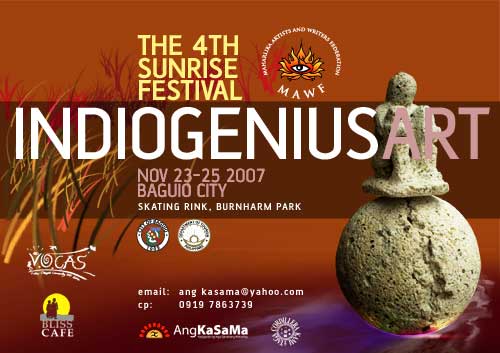
Kindly visit the web site: http://maharlikasunrisefest.com
Meme Na Mindanaw
Posted:
Wednesday, November 07, 2007
Artist Director Cyrus Nobleza depart this life
Posted:
Monday, September 03, 2007
Kahayag Community Dance and Theater Co's., present Artistic Director, Cyrus Nobleza, found lifeless due to carjack arrest at his pad in Koronadal City.
Being one of the culture and arts office staff in the province of South Cotabato, Cyrus assumed the Artistic Direction of Kahayag on 2005. He is instrumental to the groups participation to the Wi-Fi Body: Contemporary Dance Festival at the Cultural Center of the Philippines on June of 2006. His great courage of pushing the group's artistic and cultural pursuit was an inspiring contribution to the development of contemporary dance in Mindanao. His dance creations with Kahayag and his winning pieces in the Mindanao Modern Dance Competition since 2002-2006 gained him recognition and respect as choreographer from icons/personalities of Philippine dance community. His Cyber Crew Dancer (an all-male dance group he established) became popular, boosting their members to continue hone their craft as one of the respected contemporary dance groups in the region.
More than a dance artist, Cyrus is one of the respectable cultural workers in the province. He prefer to work as culture and art staff of the province in exchange of the great opportunities waiting for a top-notched registered nurse like him abroad.
May this fellow will continue to inspire us in our continuing pursuit for artistic excellence and endeavor in shaping the Filipino culture and changing the lives of the people for the better in our own way as artists and cultural workers.
Cy, you will always be remembered...
NOEL GARROVILLO
Founding Artistic Director
Kahayag Community Dance and Theater Company
Being one of the culture and arts office staff in the province of South Cotabato, Cyrus assumed the Artistic Direction of Kahayag on 2005. He is instrumental to the groups participation to the Wi-Fi Body: Contemporary Dance Festival at the Cultural Center of the Philippines on June of 2006. His great courage of pushing the group's artistic and cultural pursuit was an inspiring contribution to the development of contemporary dance in Mindanao. His dance creations with Kahayag and his winning pieces in the Mindanao Modern Dance Competition since 2002-2006 gained him recognition and respect as choreographer from icons/personalities of Philippine dance community. His Cyber Crew Dancer (an all-male dance group he established) became popular, boosting their members to continue hone their craft as one of the respected contemporary dance groups in the region.
More than a dance artist, Cyrus is one of the respectable cultural workers in the province. He prefer to work as culture and art staff of the province in exchange of the great opportunities waiting for a top-notched registered nurse like him abroad.
May this fellow will continue to inspire us in our continuing pursuit for artistic excellence and endeavor in shaping the Filipino culture and changing the lives of the people for the better in our own way as artists and cultural workers.
Cy, you will always be remembered...
NOEL GARROVILLO
Founding Artistic Director
Kahayag Community Dance and Theater Company
Nationalism and the language issue
Posted:
Wednesday, August 22, 2007
I’d like to take a modest time to discuss a few insights about language issues in the Philippine setting -- since this is relevant in the WIKA 2007 occasion. Because of this event (MARAMING WIKA, MATATAG NA BANSA), I’ve been more and more aware recently entries of a certain misunderstanding that a lot of Filipinos have thought about language vis-à-vis nationalism.
Nationalism does not equal language. Language does not equal nationalism. Perhaps they may be correlated, yet they are not the same… and this confusing of the two is an unfortunate misleading notion in our popular thinking about national (Pilipino) language, identity, and culture that really limits us from having a truly culturally diverse experience with each other.
Why is this disagrees with? In its positive sense nationalism is nothing other than a philosophy of political self-determination instigate by geo-sentiments or socio-sentiments in other terms. While language is the inner human expression of once culture. The language of the tongue varies in accordance to place, time and person. Just as the communication style of men varies from that of women because of their different experiences. The study of the English languages evolution and expansion over the last hundred years, to accommodate changing values and technological advancements, is a good example of dynamic language.
Our history tells us that the Philippines is a classic example of pseudo-cultural exploitation. After the Americans “liberated” the Filipinos from Spanish colonization in 1898, … they embarked on an intensive ten-year pacification campaign of pseudo-cultural propagation. They strictly suppressed all expression of Filipino culture --- books, plays and even the raising of the national flag. The nationwide school system organized by the American established English as the language of instruction, distorted the history of American occupation, taught American rather than Filipino history, and altogether glorified the American way of life.
Until today, this pseudo-cultural exploitation is still dominant in the Philippine society. This problem has been a system that does not encourage self-reliance on individual, cultural, and economic levels. Indeed, P.R. Sarkar wrote in his Neo-Humanism: the Liberation of Intellect: “If the people’s cultural backbone is broken, then all their struggles for political and social freedom will end in nothing. Can those necks and backs are crushed under the weight of pseudo-culture be expected to hold their heads high in any sphere of life.”
In this context, the key to the maintenance of psycho-economic exploitation is cultural exploitation. And if we think only about the present and the future, and we don’t reflectively think about our pasts, any cultural dialogue is empty and false. Any ‘multiculturalism’ based on deceptive and naive ideas of culture, is not multiculturalism at all, but some convenient and valueless conformity to substitute harmony.
Nationalism does not equal language. Language does not equal nationalism. Perhaps they may be correlated, yet they are not the same… and this confusing of the two is an unfortunate misleading notion in our popular thinking about national (Pilipino) language, identity, and culture that really limits us from having a truly culturally diverse experience with each other.
Why is this disagrees with? In its positive sense nationalism is nothing other than a philosophy of political self-determination instigate by geo-sentiments or socio-sentiments in other terms. While language is the inner human expression of once culture. The language of the tongue varies in accordance to place, time and person. Just as the communication style of men varies from that of women because of their different experiences. The study of the English languages evolution and expansion over the last hundred years, to accommodate changing values and technological advancements, is a good example of dynamic language.
Our history tells us that the Philippines is a classic example of pseudo-cultural exploitation. After the Americans “liberated” the Filipinos from Spanish colonization in 1898, … they embarked on an intensive ten-year pacification campaign of pseudo-cultural propagation. They strictly suppressed all expression of Filipino culture --- books, plays and even the raising of the national flag. The nationwide school system organized by the American established English as the language of instruction, distorted the history of American occupation, taught American rather than Filipino history, and altogether glorified the American way of life.
Until today, this pseudo-cultural exploitation is still dominant in the Philippine society. This problem has been a system that does not encourage self-reliance on individual, cultural, and economic levels. Indeed, P.R. Sarkar wrote in his Neo-Humanism: the Liberation of Intellect: “If the people’s cultural backbone is broken, then all their struggles for political and social freedom will end in nothing. Can those necks and backs are crushed under the weight of pseudo-culture be expected to hold their heads high in any sphere of life.”
In this context, the key to the maintenance of psycho-economic exploitation is cultural exploitation. And if we think only about the present and the future, and we don’t reflectively think about our pasts, any cultural dialogue is empty and false. Any ‘multiculturalism’ based on deceptive and naive ideas of culture, is not multiculturalism at all, but some convenient and valueless conformity to substitute harmony.

Anthology of essays by young Moro writers
Posted:
Saturday, August 11, 2007
Dear Friends and Colleagues,
I am proud to announce that Children of the Ever-Changing Moon, an anthology of essays by young Moro writers, will be out by the end of August. The release will coincide with the annual Manila International Book Fair on August 29 to September 2 at the World Trade Center in Pasay City. The book will then be available in National Bookstore, Powerbooks and other leading bookstores across the country by September.
Children of the Ever-Changing Moon, published by Anvil, features essays by some of our brilliant, gifted young minds today. The writers are:
 * Pearlsha Abubakar
* Ayesah Abubakar
* Sarah Matalam Alvarez
* Mucha-Shim Quiling Arquiza
* Nefertari Al Raschid-Arsad
* Allyson Banga-an
* Ayesha Merdeka Alonto-Datu Ramos
* Sittie Jamairah Disomimba
* Samira Ali Gutoc
* Sitti Djalia Turabin-Hataman
* Loren Hallilah Lao
* Zainudin Malang
* Farida D. Mending
* Gonaranao B. Musor
We have a book launch in Davao City tentatively set onSeptember 18.
Please support us by getting a copy of the book, and spreading this news to your friends and family.
If you have queries, you can reach me at 0920-2555305 / 0920-9049336.
Salam,
Teng Mangansakan
Editor
URL: http://www.morofilm.com/
:::::::::::::::::::::::::::::::::::
Gutierrez Mangansakan II, an award-winning writer and filmmaker from Maguindanao, the book will have its Davao City launch on September 18 and will be available in all leading bookstores across the country also next month.
I am proud to announce that Children of the Ever-Changing Moon, an anthology of essays by young Moro writers, will be out by the end of August. The release will coincide with the annual Manila International Book Fair on August 29 to September 2 at the World Trade Center in Pasay City. The book will then be available in National Bookstore, Powerbooks and other leading bookstores across the country by September.
Children of the Ever-Changing Moon, published by Anvil, features essays by some of our brilliant, gifted young minds today. The writers are:
 * Pearlsha Abubakar
* Ayesah Abubakar
* Sarah Matalam Alvarez
* Mucha-Shim Quiling Arquiza
* Nefertari Al Raschid-Arsad
* Allyson Banga-an
* Ayesha Merdeka Alonto-Datu Ramos
* Sittie Jamairah Disomimba
* Samira Ali Gutoc
* Sitti Djalia Turabin-Hataman
* Loren Hallilah Lao
* Zainudin Malang
* Farida D. Mending
* Gonaranao B. Musor
We have a book launch in Davao City tentatively set onSeptember 18.
Please support us by getting a copy of the book, and spreading this news to your friends and family.
If you have queries, you can reach me at 0920-2555305 / 0920-9049336.
Salam,
Teng Mangansakan
Editor
URL: http://www.morofilm.com/
:::::::::::::::::::::::::::::::::::
Gutierrez Mangansakan II, an award-winning writer and filmmaker from Maguindanao, the book will have its Davao City launch on September 18 and will be available in all leading bookstores across the country also next month.
The Maharlikan Sunrise
Posted:
Monday, May 21, 2007
Ysagani “Yatu” Ybarra author of The Maharlikan Sunrise won 4th prize in the Prout Story Writing Competition…
Read more story…

To the brave souls who gathered
At the foot of mystic twin mountains
Who jumpstarted the ripples
Of movements on new waters
Read more story…
Anoy Catague tale of indigenous art
Posted:
Thursday, February 01, 2007
Anoy Catague literally had a bloody start with art. At seven, he was urged by his teacher to join an art contest. He refused. The teacher dragged him out of the room to the session hall. "I was crying like hell, embarrassed and ashamed to face people." He won first in the contest and from then on has reaped many awards.
Of below average family, painting became Anoy's passport to artistic recognition. At 17, he worked as editorial artist of a local paper. He moved on to television, both as cameraman and artist. Theater then lured him, doing mural and related pieces.

His visual studies of the neglected brought him to exhibitions in several universities and colleges in Mindanao, even as far as Canada.
This college drop-out who dreams of a Fine Arts degree is an interesting character study as well. To his close friends, he is comic, loyal and just about everything. To acquaintances, he is shy as lamb.
But let his art speak freely of the man.
::::: Anoy is a native of Butuan City :::::
Of below average family, painting became Anoy's passport to artistic recognition. At 17, he worked as editorial artist of a local paper. He moved on to television, both as cameraman and artist. Theater then lured him, doing mural and related pieces.
His turning highlight as an artist occurred when he visited ethnic villages all over Mindanao. Drawn sentimentally to the Lumads (indigenous people), he concentrated his art to them. Since then, Anoy's work is synonymous with the Lumads way of life.
His visual studies of the neglected brought him to exhibitions in several universities and colleges in Mindanao, even as far as Canada.
This college drop-out who dreams of a Fine Arts degree is an interesting character study as well. To his close friends, he is comic, loyal and just about everything. To acquaintances, he is shy as lamb.
But let his art speak freely of the man.
::::: Anoy is a native of Butuan City :::::
