

Necessity for economic democracy
Posted:
Tuesday, August 05, 2008
By P.R. Sarkar
The first requirement for economic democracy is that the minimum requirements of a particular age -- including food, clothing, housing, education and medical treatment -- must be guaranteed to all. Not only is this an individual right, it is also a collective necessity, because the easy availability of the minimum requirements will increase the all-round welfare of society.
The second requirement for economic democracy is that increasing purchasing capacity must be guaranteed to each and every individual. In economic democracy local people will hold economic power. Consequently, local raw materials will be used to promote the economic prosperity of the local people. That is to say, the raw materials of one socio-economic unit should not be exported to another unit. Instead, industrial centres should be built up wherever raw materials are available. This will create industries based on locally available raw materials and ensure full employment for all local people.
The third requirement for economic democracy is that the power to make all economic decisions must be placed in the hands of the local people. Economic liberation is the birthright of every individual. To achieve it, economic power must be vested in the local people. In economic democracy the local people will have the power to make all economic decisions, to produce commodities on the basis of collective necessity, and to distribute all agricultural and industrial commodities.
The fourth requirement for economic democracy is that outsiders must be strictly prevented from interfering in the local economy. The outflow of local capital must be stopped by strictly preventing outsiders or a floating population from participating in any type of economic activity in the local area. For the success of economic democracy, Prout must be implemented and the economic welfare of all people must be enhanced step by step. This in turn will lead to greater opportunities for the spiritual emancipation of human beings.
Finally, it should be remembered that economic democracy is essential not only for the economic liberation of human beings, but for the universal well-being of all -- including plants and animals. Economic democracy will devise ways and means to effect the smooth progress of society by recognizing the unique value of both humans and non-humans alike.
June 1986, Calcutta
Prout in a nutshell 21
What is PROUT?
Posted:
Saturday, July 26, 2008
PROUT is a complete socio-economic theory based on an integrated view of life and comprising a wide spectrum of human activity, propounded by Shrii Prabhat Rainjan Sarkar (1921-1990) in 1959. At the time it presented an undeniable challenge to the outdated Marxist and capitalist theories whose falls it predicts. Based on practical observances rather than theoretical assumptions, PROUT remains very much a vibrant rational ideological alternative today.
The name PROUT is an acronym of PROgressive Utilization Theory. For the first time human goals and aspirations on any level of existence have been brought within the compass of a comprehensive socio-economic theory. Earlier socio-economic thought could not comprehend a synthetic approach to human physical, mental and spiritual requirements. Hence they could provide neither for the integrated development of individuals nor the wholesome adjustment with others and the environment.
Visit ProutWorld at www.proutworld.org
Sarangani Bay Festival 2008
Posted:
Saturday, May 17, 2008
Woodbridge Beach Resort in Kiamba hosted the opening program of Sarangani Bay Festival 2008 with simultaneous competitions in land and sea, including environmental awareness programs.

Sarangani Bay lies between a mangrove forest in Glan (foreground) and the majestic Mt. Matutum. -- Photo by Cocoy Sexcion
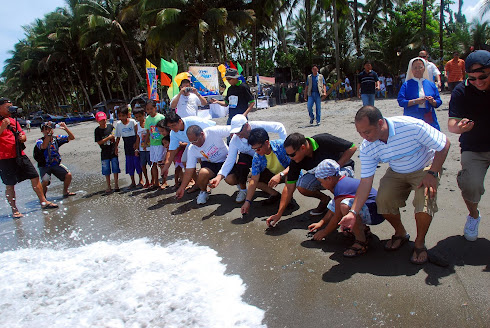
Pawikan release: Local officials led by Governor Migs Dominguez (4th from right) and the community release 30 Olive Ridley hatchlings to signal environmental consciousness and protection of the bay on the first day of Sarangani Bay Festival Friday, May 16 at Kiamba municipality. -- Photo by Cocoy Sexcion
Earlier in the day of May 16, at 7am., a clean-up in the province’s six coastal towns - Alabel, Malapatan, Glan, Maasim, Kiamba and Maitum - ushered in community participation and advocacy for Sarangani Bay.
Also slated at Woodbridge are a rowing race (lumba bugsay), cooking contest (hain kusina), an environmental arts exhibit and a techno-aqua recreational activity.
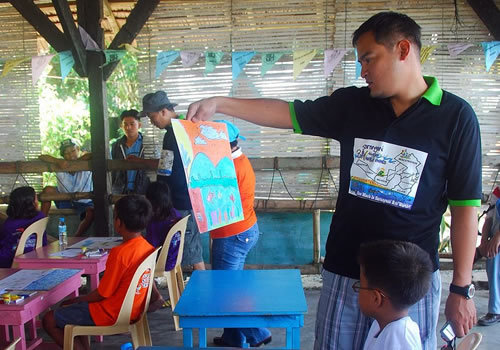
Governor Migs Dominguez looks at the artwork of a participant in the Sining at Kinaiyahan (arts and nature) contest among 8 to 12 years old children Friday, May 16, depicting this year's 2008 Sarangani Bay Festival theme: "Sarangani… Celebrating and Protecting the Treasures of the Bay" -- Photo by Cocoy Sexcion

Fisherfolk teams composed of either husband and wife, father and daughter, sister and brother, or mother and son race boats at the Lumba Bugsay event to open the Sarangani Bay Festival 2008. It is a 1.5-kilometer race from Banglay Beach to Woodbridge Resort. -- Photo by Cocoy Sexcion

Couple Bong and Norhaima Saban reach the finish line first for the Lumba Bugsay at the opening of the Sarangani Bay Festival 2008 Friday, May 16. The couple pose after winning the 1.5-kilometer race carries the top prize of P5,000 cash and a 5.5 HP boat engine. -- Photo by Cocoy Sexcion

Fisherfolk families who participated in the Lumba Bugsay event pose after reaching the shore of Woodbridge Resort at Kiamba municipality. -- Photo by Cocoy Sexcion
For the first time, the municipality of Kiamba launched the “Mountain-River-Ocean Adventure,” a human race from the jungles to the sea.
Local government units, non-government organizations and the business sector are coming together to celebrate this year’s bay festival and to increase community awareness in environmental conservation.
“For our third Sarangani Bay Festival, everybody is knocking on our doors,” Governor Migs Dominguez told a press conference last week.
“This means we’re developing equity and credibility in what we are doing, because our cause is healthy,” the governor said.
Sarangani Bay Festival, with the theme this year of “Sarangani… Celebrating and Protecting the Treasures of the Bay”, is a province-wide festival which pays tribute to the bounty of the bay through beach events.
“We are celebrating the beauty and the goodness of the bay,” said Vice Governor Steve Chiongbian Solon.
“Every year people will be reminded of how beautiful and how generous the bay has become for us that we should continue to preserve it,” Solon said.
According to Board Member Arturo Lawa, Sarangani province has “already generated interest with regards to environmental protection.”
“This is evident in the building of Septage Treatment Facilities from the Japan Bank for International Cooperation among the province’s six coastal towns,” said Lawa, chair of the Sangguniang Panlalawigan environment committee.
Lawa said in relation to the Clean Water Act, his committee was now 80% in the formulation of the Water Quality Management Board for Sarangani Bay.
On the other hand, the annual bay festival has triggered the development of beach resorts across the province to accommodate tourists.
Resort growth more than doubled in the white sand shores of Gumasa, the Boracay-like destination in Mindanao.
The tourism office has recorded an 87% increase of tourist arrivals in the province from 2005 to 2007.
**********
For more information, kindly visit this website: www.sarangani.gov.ph

Sarangani Bay lies between a mangrove forest in Glan (foreground) and the majestic Mt. Matutum. -- Photo by Cocoy Sexcion

Pawikan release: Local officials led by Governor Migs Dominguez (4th from right) and the community release 30 Olive Ridley hatchlings to signal environmental consciousness and protection of the bay on the first day of Sarangani Bay Festival Friday, May 16 at Kiamba municipality. -- Photo by Cocoy Sexcion
Earlier in the day of May 16, at 7am., a clean-up in the province’s six coastal towns - Alabel, Malapatan, Glan, Maasim, Kiamba and Maitum - ushered in community participation and advocacy for Sarangani Bay.
Also slated at Woodbridge are a rowing race (lumba bugsay), cooking contest (hain kusina), an environmental arts exhibit and a techno-aqua recreational activity.

Governor Migs Dominguez looks at the artwork of a participant in the Sining at Kinaiyahan (arts and nature) contest among 8 to 12 years old children Friday, May 16, depicting this year's 2008 Sarangani Bay Festival theme: "Sarangani… Celebrating and Protecting the Treasures of the Bay" -- Photo by Cocoy Sexcion

Fisherfolk teams composed of either husband and wife, father and daughter, sister and brother, or mother and son race boats at the Lumba Bugsay event to open the Sarangani Bay Festival 2008. It is a 1.5-kilometer race from Banglay Beach to Woodbridge Resort. -- Photo by Cocoy Sexcion

Couple Bong and Norhaima Saban reach the finish line first for the Lumba Bugsay at the opening of the Sarangani Bay Festival 2008 Friday, May 16. The couple pose after winning the 1.5-kilometer race carries the top prize of P5,000 cash and a 5.5 HP boat engine. -- Photo by Cocoy Sexcion

Fisherfolk families who participated in the Lumba Bugsay event pose after reaching the shore of Woodbridge Resort at Kiamba municipality. -- Photo by Cocoy Sexcion
For the first time, the municipality of Kiamba launched the “Mountain-River-Ocean Adventure,” a human race from the jungles to the sea.
Local government units, non-government organizations and the business sector are coming together to celebrate this year’s bay festival and to increase community awareness in environmental conservation.
“For our third Sarangani Bay Festival, everybody is knocking on our doors,” Governor Migs Dominguez told a press conference last week.
“This means we’re developing equity and credibility in what we are doing, because our cause is healthy,” the governor said.
Sarangani Bay Festival, with the theme this year of “Sarangani… Celebrating and Protecting the Treasures of the Bay”, is a province-wide festival which pays tribute to the bounty of the bay through beach events.
“We are celebrating the beauty and the goodness of the bay,” said Vice Governor Steve Chiongbian Solon.
“Every year people will be reminded of how beautiful and how generous the bay has become for us that we should continue to preserve it,” Solon said.
According to Board Member Arturo Lawa, Sarangani province has “already generated interest with regards to environmental protection.”
“This is evident in the building of Septage Treatment Facilities from the Japan Bank for International Cooperation among the province’s six coastal towns,” said Lawa, chair of the Sangguniang Panlalawigan environment committee.
Lawa said in relation to the Clean Water Act, his committee was now 80% in the formulation of the Water Quality Management Board for Sarangani Bay.
On the other hand, the annual bay festival has triggered the development of beach resorts across the province to accommodate tourists.
Resort growth more than doubled in the white sand shores of Gumasa, the Boracay-like destination in Mindanao.
The tourism office has recorded an 87% increase of tourist arrivals in the province from 2005 to 2007.
**********
For more information, kindly visit this website: www.sarangani.gov.ph
Biofuels competing with food crops
Posted:
Tuesday, April 08, 2008
The Philippine government wants farmers to plant crops for biofuels on a vast scale. But could the quest for green energy create food shortages?
By Imelda V Abano
Growing world energy demand, the insecurity of long-term supply and the consequences of fossil fuel use for climate change are driving governments to look for alternatives. To meet rising energy needs, many countries are promoting the production and use of biofuels - energy extracted as a gas, liquid or oil from plants.
Derived from food crops such as corn, sugarcane, soybean, oil palm and sugarbeet, biofuel production has been on the rise in recent years. It is seen by many as a clean form of energy in an era of soaring oil prices and concerns over carbon emissions.
Jatropha, a plant originating in Central America that grows wild in many developing countries, including South Africa, India, Thailand, Malaysia, Indonesia, China and the Philippines, has suddenly found itself at the centre of a new phase in the world's alternative energy boom.
In the Philippines, there is currently much hype surrounding its production as a source of renewable fuel. Philippine President Gloria Macapagal-Arroyo has signed into law the Biofuels Act which mandates a minimum one per cent biodiesel blend and five per cent bioethanol blend in all diesel and gasoline fuels. To meet demand, the government is aggressively pushing for the cultivation of jatropha, believing it to be one of the best candidates for future biofuel production.
The government, through the Philippine National Oil Co.-Alternative Fuels Corp, is now looking at some 1.2 million hectares for jatropha production in the southern island of Mindanao. It is also busy identifying more than 400,000 hectares of land for private sector investments.
Jatropha curcas is a drought-tolerant non-edible shrub. It produces fruits the size of golf balls which contain oil that can be converted into biodiesel, a substitute for fossil fuel.
According to Rhandy Tubal, research specialist at the Department of Environment and Natural Resources in Cordillera, farmers who have received training to grow jatropha are enthusiastic about the crop. He says the cultivation of the plant could provide the first step out of poverty for Filipino farmers and claims that, depending on the density of the plants, each hectare can yield jatropha oil worth nearly US$2,000 a year.
"We are in the initial stage of planting jatropha and we are very optimistic that it is indeed one of the best candidates for biofuel. Farmers are very excited about its production," Tubal says, adding that only idle land would be used for jatropha planting to avoid competition with other crops.
However, research from Australia suggests the plant will need more intensive inputs to produce the oil used for biofuels and it can take several years to develop optimum yields. Furthermore, some experts warn the move may use up precious land that could be used to grow food and may eventually hurt subsistence farmers. Concerns over possible future food shortages have generated a ‘food versus fuel’ debate in the country.
Rachel Smolker, a biofuels specialist and research biologist for the US-based environmental group the Global Justice Ecology Project, fears the global rush to switch from oil to energy derived from plants will drive deforestation, push small farmers off the land and lead to serious food shortages and increased poverty unless carefully managed.
"If food sources become biofuels, that may lead to shortages and raise prices. The promotion of biofuels will have an impact on local food security as some fuel crops are also food crops," Smolker says.
Her view is echoed by Philippine Senator Miriam Santiago, author of the 2007 Biofuels Act, who has sought more governmental oversight of biofuels development, saying that backing biofuels could adversely affect the country's ability to produce its own food.
"Biofuel is land-based and will eventually compete with food. Because the Philippines has a small land area, biofuel production will tend to encroach on food production. Corporations are already searching for millions of hectares for jatropha alone. We have to step on the brakes and decelerate," she says.
Santiago thinks the Philippines "will not prosper by betting only on the biofuels option". She says the government should explore other alternative energy sources such as wind, solar, hydropower, geothermal and biomass.
But the Philippines' Environment Secretary Lito Atienza has defended the government's massive jatropha cultivation for the biofuels programme, saying it will not imperil the country's food supply.
"Jatropha is a non-food crop. So the issue over food versus fuel is not a debate about this crop. Jatropha grows on idle lands, particularly denuded mountains and forests, unfit for food crop cultivation, so it will not compete with land used for the production of food," Atienza says.
Widespread jatropha cultivation is fairly new in the Philippines. It is only recently, with the news that jatropha can be a source of biodiesel, that people have started planting larger areas of the crop.
All the more reason, according to Dr Emil Javier, president of the National Academy of Science and Technology, to check out its credentials. "The Philippines should do its homework and conduct thorough research on jatropha and see its viability compared with other alternative crops," he says.
The challenge, believes Achim Dobermann, a scientist from the Philippine-based International Rice Research Institute, is to ensure a balance between food and biofuel production. "There is an urgent need to strengthen policy research in order to avoid decisions that may lead to competition between food and bioenergy."
******
Imelda V Abano is a freelance reporter based in Bagio, in the northern Philippines. She wrote this article as a result of a fellowship awarded by the Climate Change Media Partnership – a collaboration of Panos, Internews and IIED which supports journalists to investigate climate change issues.
This feature is published by Panos Features and can be reproduced free of charge. Please credit the author and Panos Features and send a copy to External Relations, Panos London, 9 White Lion St, London N1 9PD, UK. Email: media@panos.org.uk
Earth Hour Campaign
Posted:
Friday, March 14, 2008
On 29 March 2008 the Philippines will join countries around the world as we literally "turn the lights out" for Earth Hour - an event that will fuel awareness on climate change and prove that when the people of the world work together, they can make a difference in the fight against global warming.
Earth Hour will take place throughout the Philippines from 8 to 9 in the evening on Saturday night, 29 March 2008. WWF invites you to participate by shutting off lights for 60 minutes, organizing your own "lights-out" event or by forwarding this mail to your friends, workmates and family.
Launched in Australia on the 31st of March 2007, Earth Hour moved 2.2 million people and 2100 businesses in Sydney to turn off their lights for one hour. This massive collective effort reduced the city's energy consumption by 10.2% for one hour. With Sydney icons like the Harbour Bridge and Opera House turning their lights off and unique events such as weddings by candlelight, the world took notice. Inspired by the collective effort of millions of Sydneysiders, many major global cities are joining Earth Hour in 2008, turning a symbolic event into a global movement.
YOUR participation will go a long way in spreading the message that we, as individual droplets working collectively - can create an impetus far more powerful than the mightiest of rivers. For more information, log on to the WWF Earth Hour page at: www.earthhour.org.

If you want to learn more about how else you can help make Earth Hour in the Philippines a success, reply to this email or drop us a line at (632) 920-7931, (632)920-7923, or (632)920-7926
Teena G. Santiago
Marketing Services Manager
WWF-Philippines/
Kabang Kalikasan ng Pilipinas
JBD Plaza, 56 Mindanao Avenue
Bagong Pag-Asa, Quezon City
Philippines
Phone: + 63 2 920-7923 or 26
Fax: +63 2 454-3533
Mobile: +63 920 923-6998
email: tsantiago@wwf.org.ph
Website: http://wwf.org.ph
Earth Hour will take place throughout the Philippines from 8 to 9 in the evening on Saturday night, 29 March 2008. WWF invites you to participate by shutting off lights for 60 minutes, organizing your own "lights-out" event or by forwarding this mail to your friends, workmates and family.
Launched in Australia on the 31st of March 2007, Earth Hour moved 2.2 million people and 2100 businesses in Sydney to turn off their lights for one hour. This massive collective effort reduced the city's energy consumption by 10.2% for one hour. With Sydney icons like the Harbour Bridge and Opera House turning their lights off and unique events such as weddings by candlelight, the world took notice. Inspired by the collective effort of millions of Sydneysiders, many major global cities are joining Earth Hour in 2008, turning a symbolic event into a global movement.
YOUR participation will go a long way in spreading the message that we, as individual droplets working collectively - can create an impetus far more powerful than the mightiest of rivers. For more information, log on to the WWF Earth Hour page at: www.earthhour.org.
If you want to learn more about how else you can help make Earth Hour in the Philippines a success, reply to this email or drop us a line at (632) 920-7931, (632)920-7923, or (632)920-7926
Teena G. Santiago
Marketing Services Manager
WWF-Philippines/
Kabang Kalikasan ng Pilipinas
JBD Plaza, 56 Mindanao Avenue
Bagong Pag-Asa, Quezon City
Philippines
Phone: + 63 2 920-7923 or 26
Fax: +63 2 454-3533
Mobile: +63 920 923-6998
email: tsantiago@wwf.org.ph
Website: http://wwf.org.ph
Women's Rights
Posted:
Saturday, March 08, 2008
We, men and women, are the progeny of the same Supreme Consciousness. Women and men are equally divine and inherit similar and equal rights to life, liberty and expression. The significance of life does not lie only in living. Animals also live. But life to us means something more -- rather something much more.

To us life means living for a great cause. Life implies the endeavour to have the freedom to express one's potentialities in the physical, economic, psychic and spiritual realms. It means real liberty and not license to commit anything good or bad.
In the annals of human history we do find women whose memory glorifies not only womanhood, but the entire human world. In philosophy and spirituality, social reform and educational pursuits, science and technology, they stand second to none. Women are found discussing the riddles of philosophy, solving problems of social and educational reform, and are inspiring men in times of struggle. They have their potentiality no less than men. The difference in natural and biological characteristics between men and women speaks only of coordinated cooperation, not of subordinated cooperation.
Yet the annals of history depict the sad and painful episodes of women's exploitation throughout the world. To fulfil this sinister design, dogmas were created which led to psycho-economic exploitation. Dogmas were cunningly popularized and women were degenerated to slavery. Psychic exploitation has been infused into the minds of women and many symbols which are religiously observed are nothing but symbols of slavery. In many religions of the world today women are not allowed to become priests in the religious hierarchy.
Women's exploitation is more or less the same everywhere. Is it not a fact that in many countries even franchise rights were not given equally to men and women?
Even today women are slaves to the male-dominated social order. This is not only bad but deplorable. We should decry such domination of women and their psycho-economic exploitation through the evil design of dogmas. To abolish dogma and liberate women from psychic exploitation, there should be:
We stand to create a powerful, dynamic and upsurging social consciousness, especially among women, so that they are inspired to rise, abolish dogma and annihilate all symbols of slavery, and usher in a new era of coordinated cooperation and glorious achievement. Let women be the vanguard of a new revolution which humanity must achieve for a glorious tomorrow.
by: Prabhat Ranjan Sarkar
20 April 1981, Calcutta
A Few Problems Solved Part 9
In the annals of human history we do find women whose memory glorifies not only womanhood, but the entire human world. In philosophy and spirituality, social reform and educational pursuits, science and technology, they stand second to none. Women are found discussing the riddles of philosophy, solving problems of social and educational reform, and are inspiring men in times of struggle. They have their potentiality no less than men. The difference in natural and biological characteristics between men and women speaks only of coordinated cooperation, not of subordinated cooperation.
Yet the annals of history depict the sad and painful episodes of women's exploitation throughout the world. To fulfil this sinister design, dogmas were created which led to psycho-economic exploitation. Dogmas were cunningly popularized and women were degenerated to slavery. Psychic exploitation has been infused into the minds of women and many symbols which are religiously observed are nothing but symbols of slavery. In many religions of the world today women are not allowed to become priests in the religious hierarchy.
Women's exploitation is more or less the same everywhere. Is it not a fact that in many countries even franchise rights were not given equally to men and women?
Even today women are slaves to the male-dominated social order. This is not only bad but deplorable. We should decry such domination of women and their psycho-economic exploitation through the evil design of dogmas. To abolish dogma and liberate women from psychic exploitation, there should be:
- Free education for all women in all countries of the world.
- No discrimination in the social, educational and religious realms.
- The provision of economic and social security to all women.
We stand to create a powerful, dynamic and upsurging social consciousness, especially among women, so that they are inspired to rise, abolish dogma and annihilate all symbols of slavery, and usher in a new era of coordinated cooperation and glorious achievement. Let women be the vanguard of a new revolution which humanity must achieve for a glorious tomorrow.
by: Prabhat Ranjan Sarkar
20 April 1981, Calcutta
A Few Problems Solved Part 9
Hatag Kalinaw 2008 project grant
Posted:
Wednesday, February 06, 2008
Hatag Kalinaw 2008 is a youth-led project grant competition for school and community-based youth organisations in Mindanao on how the ideals of peace can be achieved through mutual understanding and entrepreneurship. Winning organisations will receive up to PHP 100,000 each to implement its project within a 6-month period.
What should the proposal be about?
* Project proposals should address issues on the ideals of peace, mutual understanding, and development among young people in Mindanao
* It should espouse entrepreneurship in the form of savings, economic, or livelihood activities
* It should utilise the concept of “self-help” as opposed to “dole-out
* It should be a consultative and participatory process to ensure ownership and enhanced sustainability to promote community-based entrepreneurial activities

For further information and to download application form, please visit: web site
What should the proposal be about?
* Project proposals should address issues on the ideals of peace, mutual understanding, and development among young people in Mindanao
* It should espouse entrepreneurship in the form of savings, economic, or livelihood activities
* It should utilise the concept of “self-help” as opposed to “dole-out
* It should be a consultative and participatory process to ensure ownership and enhanced sustainability to promote community-based entrepreneurial activities
For further information and to download application form, please visit: web site